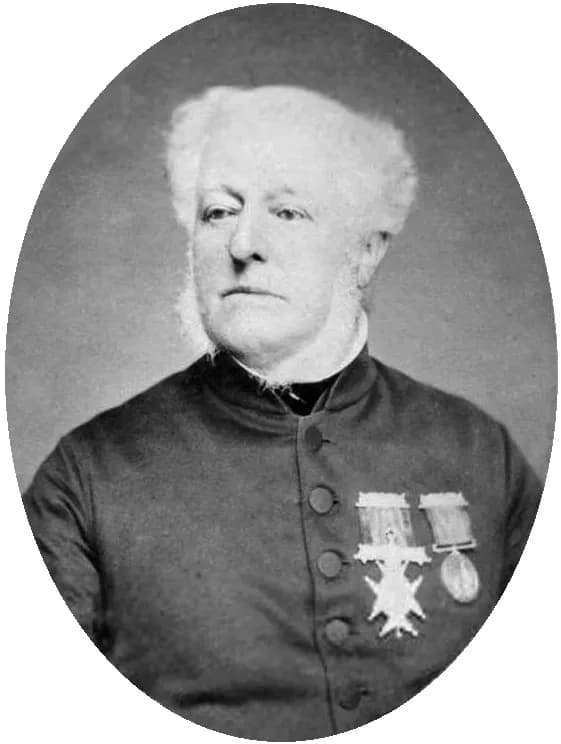
Dr William Penny Brookes was a Victorian physician and social reformer whose vision for open, inclusive athletic competition laid the foundations for the modern Olympic Games. Born, raised, and buried in Much Wenlock, his legacy remains woven into the fabric of the Telford and Wrekin borough today.
The Making of a Reforming Doctor
William Penny Brookes was born on 13 August 1809 in Much Wenlock, the son of a local doctor. He studied medicine at St Thomas' Hospital in London, followed by further training in Paris hospitals and six months in Padua studying herbal medicines and botany. He returned to Much Wenlock in 1831 to take over his father's medical practice following his father's death.
Brookes was more than a physician. He became a Justice of the Peace in 1841 and served as magistrate for over forty years. He contributed botanical research to scholarly works on Shropshire flora and was an active educationalist. His particular passion, however, was the belief that physical education should be available to all social classes, not merely the wealthy elite.
The Wenlock Olympian Games
In 1841, Brookes founded the Wenlock Agricultural Reading Society to provide library and educational opportunities for working people. Nine years later, on 25 February 1850, the Society resolved to establish "The Olympian Class" with a stated purpose: "for the promotion of the moral, physical and intellectual improvement of the inhabitants of the town and neighbourhood of Wenlock and especially of the working classes, by the encouragement of outdoor recreation."
The first Wenlock Olympian Games were held at Much Wenlock racecourse on 22 and 23 October 1850. Events included running, hurdles, football, cricket, and quoits. Early editions featured what would now be considered novelties; the 1851 Games included an "Old Women's Race" with a pound of tea as the prize. The Games evolved to include cycling on penny-farthings and throwing the javelin.
Following a dispute with the Agricultural Reading Society in November 1860, the Olympian Class separated and became the Wenlock Olympian Society, which continues to this day. Brookes later co-founded the National Olympian Association in 1865, and the first National Olympian Games were held at London's Crystal Palace in 1866, attracting over 10,000 spectators.
The French Connection: Inspiring the Modern Olympics
Brookes' influence extended far beyond Shropshire. In 1889, he invited Baron Pierre de Coubertin, a French educationalist campaigning for physical education reform, to visit Much Wenlock. Coubertin accepted, and in October 1890 he stayed at Brookes' family home on Wilmore Street for several days.
A special Wenlock Olympian Games was staged in Coubertin's honour, complete with the ceremonial pageantry that Brookes had pioneered. Following the competition, a dinner was held at The Raven Hotel, which still stands in the town today.
Coubertin was profoundly moved by what he witnessed. He later wrote: "If the Olympic Games that Modern Greece has not yet been able to revive still survives there today, it is due, not to a Greek, but to Dr W P Brookes." The two men corresponded for several years. In 1891, Coubertin sent Brookes a commemorative medal to be awarded at the Wenlock Games. In 1894, Brookes was named an honorary delegate to the Sorbonne Congress, where the International Olympic Committee was established, though ill health prevented him from attending.
Brookes died on 11 December 1895, four months before the first modern Olympic Games were held in Athens under IOC auspices in 1896.
Telford and Wrekin Connection
Much Wenlock, where Brookes lived and worked his entire life, lies within the modern Telford and Wrekin unitary authority. The historical Borough of Wenlock, which at its height was the largest borough in England outside London, encompassed 71 square miles including Madeley, Broseley, and Ironbridge; all now part of Telford.
The William Brookes School in Much Wenlock bears his name, offering secondary education and sixth form studies with an academy status. The Edge Arts Centre at the school provides cinema, theatre, dance, and music performances for the local community.
Legacy and Recognition
The Wenlock Olympian Society continues to organise annual Games, recognised by both the International Olympic Committee and the British Olympic Association. The 2012 London Olympic Games paid direct tribute when one of the two official mascots was named "Wenlock" in honour of the town and its Olympian Society. On 30 May 2012, the Olympic flame was carried through Much Wenlock during the torch relay.
In 1994, IOC President Juan Antonio Samaranch visited Holy Trinity Church in Much Wenlock to lay a wreath on Brookes' grave. He stated: "I came to pay homage and tribute to Dr Brookes, who really was the founder of the modern Olympic Games."
Brookes is buried at Holy Trinity Church on Wilmore Street, where a memorial tablet hangs on the west wall of the nave. His refurbished grave, surrounded by iron railings surmounted by olive crowns, can be visited in the churchyard. The Wenlock Olympian Society maintains a heritage trail for visitors wishing to walk in Brookes' footsteps through the town.
The doctor who began with a simple belief; that sport should be for everyone; left an inheritance that spans the globe, yet remains rooted firmly in the Shropshire town he called home.