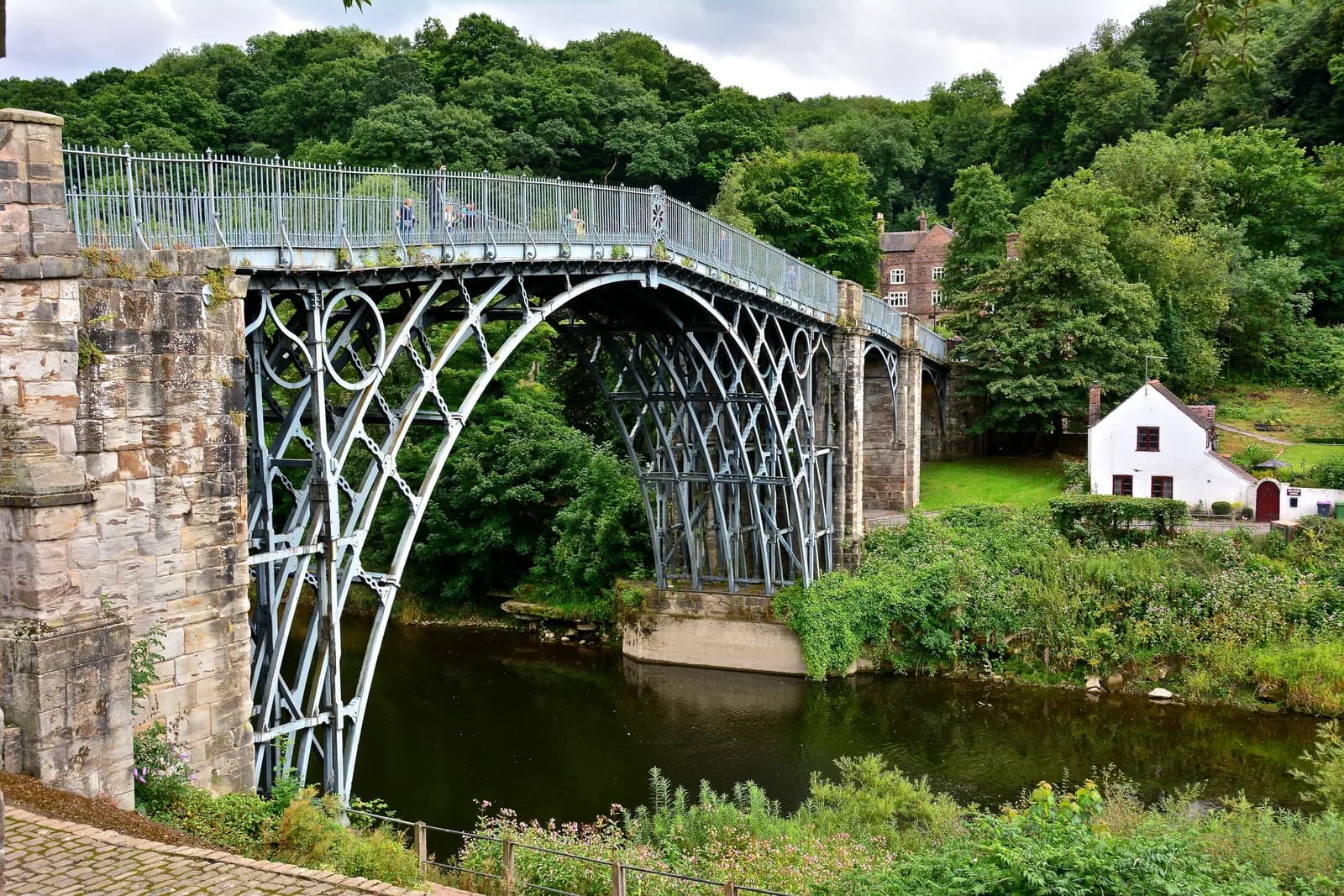
The Iron Bridge stands as the first major structure in the world built from cast iron, marking a pivotal moment in engineering history when its five sectional ribs first spanned the River Severn on 2 July 1779.
The bridge opened to the public on 1 January 1781, transforming not only the landscape of Telford but demonstrating for the first time that cast iron could serve as a structural material for large-scale construction.
Design and Construction
The bridge was designed by Thomas Farnolls Pritchard, a Shropshire architect who died in December 1777, just one month after construction began. Abraham Darby III, the grandson of Abraham Darby I and ironmaster at the Coalbrookdale Company, oversaw the casting and building of the structure.
The project required 378 long tons and 10 cwt of cast iron, formed into almost 1,700 individual components. The heaviest single piece weighed 5.5 long tons. Each component was cast individually to fit rather than being standardised, requiring precise craftsmanship from the Coalbrookdale foundry where Abraham Darby I had first successfully smelted iron with coke in 1709.
Engineering Innovation
The Iron Bridge spans 100 feet 6 inches across the Severn Gorge, linking the industrial town of Broseley with the mining town of Madeley and the industrial centre of Coalbrookdale. An inscription on the bridge records its origins: "This bridge was cast at Coalbrook-Dale and erected in the year MDCCLXXIX."
The structure employed five sectional cast-iron ribs, assembled using innovative carpentry jointing techniques adapted for iron. This method proved revolutionary, establishing cast iron as a viable material for bridge construction worldwide.
The Severn Gorge Setting
The bridge sits within the Ironbridge Gorge, a location of significant geological and industrial importance. The gorge lies entirely within the civil parish of The Gorge in the Telford and Wrekin borough. The area had previously relied on a ferry service between Madeley and Benthall to cross the river.
When completed, the bridge demonstrated remarkable resilience. During the devastating flood of 1795, which destroyed all other bridges across the Severn, the Iron Bridge survived due to its strength and compact profile against the water.
Financial Undertaking
The project was funded through subscribers who raised between £3,000 and £4,000 in 1775. The original budget stood at £3,250, though costs eventually reached approximately £6,000. Abraham Darby III covered the excess himself, ensuring the bridge's completion despite the financial overruns.
Global Influence and Recognition
The success of the Iron Bridge had considerable influence on developments in technology and architecture globally. Its construction directly inspired subsequent cast iron bridges, including Wearmouth Bridge built in 1796, and influenced the work of Thomas Telford, the engineer after whom the modern town of Telford is named.
The bridge was designated a Scheduled Monument in January 1934 and a Grade I Listed Building in April 1983. It formed the centrepiece of the Ironbridge Gorge UNESCO World Heritage Site, inscribed in 1986 under criteria recognising its Outstanding Universal Value to human history. The American Society of Civil Engineers designated it an International Civil Engineering Landmark in 1979.
Modern Conservation and Public Access
The bridge closed to vehicular traffic on 18 June 1934. Tolls were abolished in 1950 when the structure transferred to public ownership, and it has remained free for pedestrian access since that time. Telford and Wrekin Council currently owns the bridge.
A major conservation project took place between 2017 and 2018, costing £3.6 million and representing English Heritage's largest-ever conservation undertaking. Forensic analysis revealed the bridge's original colour was red-brown rather than the blue-grey it had been painted, and the restoration returned it to this historical appearance. The project received funding from the Hermann Reemtsma Foundation and raised £47,545 through crowdfunding, winning a Europa Nostra Award in 2020. The bridge reopened on 6 December 2018.
Local and Economic Impact Today
The Iron Bridge attracts over 600,000 visitors annually to the Ironbridge Gorge World Heritage Site. This tourism supports local museums, hospitality businesses, and the broader Telford economy, representing a transformation from industrial powerhouse to heritage destination.
The structure remains a defining symbol of Telford, representing both the town's industrial origins and its present-day identity. Its survival and continued preservation ensure that the innovation of 1779 remains visible to residents and visitors alike.